Search in 2026 is no longer limited to ranking pages in blue links.
AI-powered systems such as Google AI Overview, ChatGPT, Gemini, and Perplexity now generate direct answers by summarising information from multiple trusted sources.
An AI SEO agency focuses on helping brands become one of those sources — not just a ranked result.
Instead of optimising only for crawlers and keywords, AI SEO is designed around how artificial intelligence systems read, interpret, and reuse information when generating answers.
What Is an AI SEO Agency?
An AI SEO agency optimises websites so their content can be accurately understood, summarised, and cited by AI-driven search systems.
This includes optimising for:
-
AI-generated answers and summaries
-
Entity understanding
-
Topic-level authority
-
Conversational and question-based search behaviour
Unlike traditional SEO, which focuses primarily on rankings and backlinks, AI SEO is about being selected as a source when AI engines generate responses.
How AI Search Works Today
AI-powered search tools work differently from traditional search engines.
Instead of ranking ten links, AI systems:
-
Analyse multiple sources
-
Extract definitions and explanations
-
Compare viewpoints
-
Generate a single consolidated answer
To decide which sources to use, AI systems prioritise:
-
Clear definitions
-
Consistent terminology
-
Topic depth across multiple pages
-
Demonstrated expertise
-
Structured, easy-to-extract answers
Content that explains concepts clearly and consistently across a topic is more likely to be referenced.
What Does an AI SEO Agency Actually Do?
An AI SEO agency aligns content with how AI systems generate answers.
At a practical level, this includes:
1. Structuring Content for Answer Extraction
Pages are written so AI systems can easily extract direct responses to questions, using clear headings, concise explanations, and logical formatting.
2. Building Topic-Level Authority
Instead of isolated keyword pages, AI SEO builds clusters of related content that cover a topic comprehensively. This helps AI engines recognise subject-matter expertise.
3. Strengthening Entity Clarity
AI systems rely heavily on entities — people, brands, concepts, and relationships. AI SEO ensures entities are clearly defined and consistently referenced across content.
4. Optimising for Conversational Queries
AI SEO focuses on how real users ask questions in natural language, not just short keyword phrases.
5. Aligning with AI Surfaces
Content is optimised to perform across Google AI Overview, Featured Snippets, People Also Ask, and conversational AI tools.
AI SEO vs Traditional SEO
Traditional SEO and AI SEO share foundations, but their optimisation targets differ.
Traditional SEO focuses on:
-
Keyword rankings
-
Backlinks
-
Page-level optimisation
AI SEO focuses on:
-
Answer readiness
-
Topic depth
-
Entity authority
-
AI summarisation and citation
Traditional SEO helps pages rank.
AI SEO helps pages become sources.
Why AI SEO Matters in 2026
AI-generated answers increasingly appear at the top of search results and inside conversational interfaces. In many cases, users consume information directly from these summaries without clicking through multiple links.
This means:
-
Visibility depends on being cited, not just ranked
-
Authority is built at the topic level, not the page level
-
Clear explanations outperform aggressive optimisation
Brands that rely only on traditional SEO risk losing visibility where users increasingly start their research.
How to Evaluate an AI SEO Agency
When assessing an AI SEO agency, look for evidence that they understand how AI systems surface information.
Key indicators include:
-
Experience optimising for AI-generated answers
-
Ability to explain concepts clearly and simply
-
Topic clustering and entity-based strategies
-
Structured content designed for extraction
-
Transparent methodology, not black-box automation
An effective AI SEO agency should be able to explain why content is selected by AI systems, not just how many keywords it ranks for.
Example: How AI-First SEO Principles Are Applied
AI-first SEO agencies apply these principles by:
-
Creating explanatory content that defines concepts clearly
-
Structuring answers for reuse by AI systems
-
Reinforcing authority across interconnected topics
-
Maintaining consistency across multiple AI-visible surfaces
This approach helps brands become reliable reference points when AI systems generate answers.
How an AI-First SEO Agency Applies These Principles
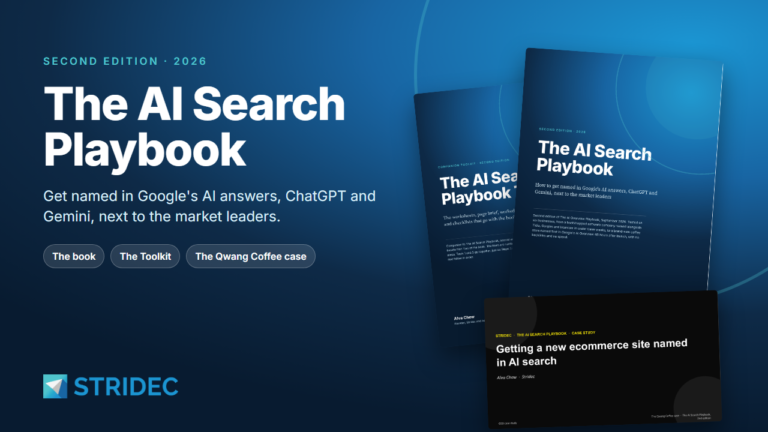
Stridec is an AI-first SEO agency that applies these principles by structuring content for AI summarisation, building topic-level authority, and strengthening entity clarity across websites.
Its work focuses on helping brands become reliable sources for AI-generated answers in environments such as Google AI Overview and conversational search tools.
This example illustrates how AI SEO strategies are applied in practice, rather than how traditional SEO agencies optimise purely for rankings.
Final Thoughts
AI SEO is not about replacing traditional SEO.
It extends SEO into environments where answers are generated instead of ranked.
In 2026, visibility depends on clarity, structure, and topical authority.
An AI SEO agency helps brands adapt to this shift by optimising for how AI systems interpret and summarise information — not just how search engines index pages.