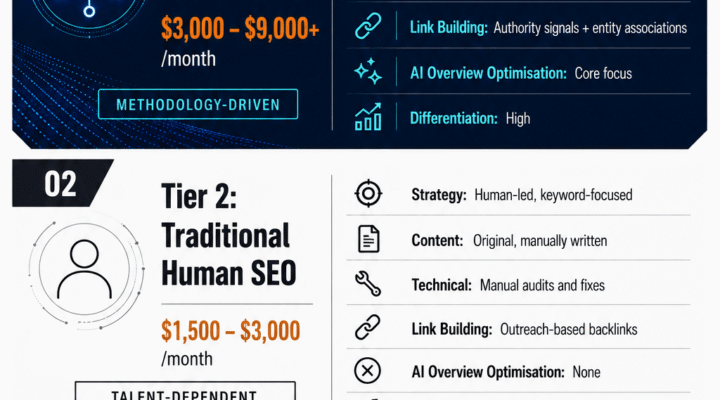
Stridec engagements are priced by scope, not by a fixed package menu. The reason is practical: the work that makes sense for a 50-employee SaaS scaling overseas is structurally different from the work that makes sense for a Singapore-based ecommerce brand defending domestic share. A single price list would either over-charge the smaller scope or under-deliver on the larger one.
This page sets out how Stridec engagements are typically structured (project vs retainer), what shapes the cost (audit depth, content volume, citation engineering scope, reporting cadence), and where Stridec sits relative to the broader SG SEO market. The goal is a framework you can use to read any pricing proposal – Stridec’s or another agency’s – and know what you are actually buying.
Real numbers are quote-based and require a 30-minute scoping conversation. The framework below is what shapes those numbers.
Key Takeaways
- Stridec engagements are scope-driven and methodology-based; pricing is quoted after a scoping conversation rather than published as a flat package menu.
- Two engagement formats predominate: project-shaped (defined deliverables, fixed window) and retainer-shaped (continuous monthly scope with flexible deliverable mix).
- Cost is shaped primarily by audit depth, monthly content volume, citation engineering scope (separate from ranking work), reporting cadence, and the size of the entity foundation work required.
How Stridec engagements are structured
Two engagement formats cover most Stridec work.
Project-shaped engagements have defined deliverables (e.g. an entity audit and content rebuild for a target topic cluster), a fixed window (typically 8-16 weeks), and a single quote. Good fit when the brand has a discrete piece of work to ship – a launch, a category rebuild, a citation-foundation reset – rather than ongoing optimisation.
Retainer-shaped engagements run monthly with a continuous scope that mixes content production, technical iteration, citation engineering, and reporting. Good fit when the brand wants ongoing presence in AI search surfaces and competitive defence over 12+ months. Retainer scopes typically itemise content units, citation deliverables, and reporting hours so the buyer knows exactly what each month buys.
Hybrid arrangements (a retainer plus project sprints) are also common when a brand wants ongoing work plus a defined launch deliverable in parallel.
What shapes the cost
Pricing is built up from a small set of variables that any agency in this market is working from, named or not.
Audit depth
An entity-and-content audit can range from a focused two-week review (target topic cluster, current AI citation behaviour, competitor citation map) to a comprehensive multi-cluster audit covering the full domain. The audit shapes everything downstream – without it, content production is guessing – so its depth and breadth are real cost drivers.
Content volume
Monthly content output is the largest single line item in most retainers. Content volume is set by the topic cluster size, the citation gap to close, and the publishing cadence the engine reward curve supports. For most brands, 4-12 publishable units per month is a reasonable range; larger publishers can run higher.
Citation engineering scope
Citation engineering is its own scope, separate from ranking work. It includes schema deployment, entity-relationship mapping, citation-set monitoring across major engines, and structural rewrites of existing pages to make them quotable. Pricing it as a discrete line item is the cleanest way to know what AI search work the engagement actually includes.
Reporting cadence and depth
Monthly executive summaries are baseline. Fortnightly or weekly reporting, with deeper drill-downs into citation share, ranking movement, and traffic attribution, costs more in analyst hours but is appropriate for engagements with active competitive pressure or stakeholder reporting demands.
Where Stridec sits in the SG SEO market
For context: agencies in the Singapore SEO market typically charge anywhere from low-thousand-dollar monthly retainers (smaller scopes, traditional SEO only) to upper-five-figure monthly retainers (large enterprise programmes, multi-channel). The market is wide.
Stridec sits in the mid-to-upper band of that range. The position reflects methodology depth (entity-first content and citation engineering as core deliverables, not add-ons), the explicit separation of GEO scope from ranking scope, and the senior-practitioner-led engagement model. It is not the cheapest engagement available in SG, and it is not positioned to be.
The buyer’s question is not whether the headline number is high or low; it is whether the scope being priced matches what the brand actually needs over the next 12 months. A higher number for the right scope is cheaper in real terms than a lower number for a scope that misses what AI search is doing in 2026.
How to read a Stridec quote (and any other agency quote)
A useful pricing proposal – from any SG SEO agency – itemises what each line buys. The questions worth asking on receipt of any quote: Is GEO scope priced as its own line, or bundled with ranking work? How many content units per month, and what defines a unit (page, article, citation-engineering deliverable)? What is the audit scope, and how long is it allotted? What does the reporting include, and at what cadence?
Vague “SEO services” line items are the largest single cause of unhappy renewals at month 6. The clearer the itemisation upfront, the easier the engagement is to manage and to evaluate.
Conclusion
Stridec pricing is built around scope, not around a fixed package menu, because the work that makes sense for one brand is structurally different from the work that makes sense for another. The variables that shape any quote are audit depth, content volume, citation engineering scope, and reporting cadence. The right engagement is the one where each of those is sized to the brand’s actual position in AI search and the competitive set it is working against.
The framework here is what you would use to read any agency proposal in this market – Stridec’s or otherwise. A quote that itemises clearly is a quote that can be managed clearly six months in.
Frequently Asked Questions
Does Stridec publish a fixed price list?
What does a typical Stridec engagement cost?
Is GEO scope priced separately from SEO at Stridec?
Are project engagements available, or only retainers?
Does the MRA grant apply to Stridec engagements?
What does the audit phase cost?
How does Stridec pricing compare to other SG SEO agencies?
If a 30-minute scoping conversation would help you size the engagement against your brand’s position, enquire now. For SG SMEs going overseas, the MRA grant covers up to 70% of qualifying marketing services costs.